
Introduction
AWS Simple Notification Service (SNS) is a fully managed messaging service that enables decoupled and distributed communication between microservices, applications, and end-users. It’s primarily designed around the publish/subscribe (pub/sub) pattern, where a publisher sends messages to a topic, and multiple subscribers receive those messages simultaneously.
Developers often use SNS to send alerts, push notifications, and trigger serverless workflows using AWS Lambda, SQS, or HTTP endpoints. This design provides flexibility, scalability, and fault tolerance in modern architecture.
Core Architecture
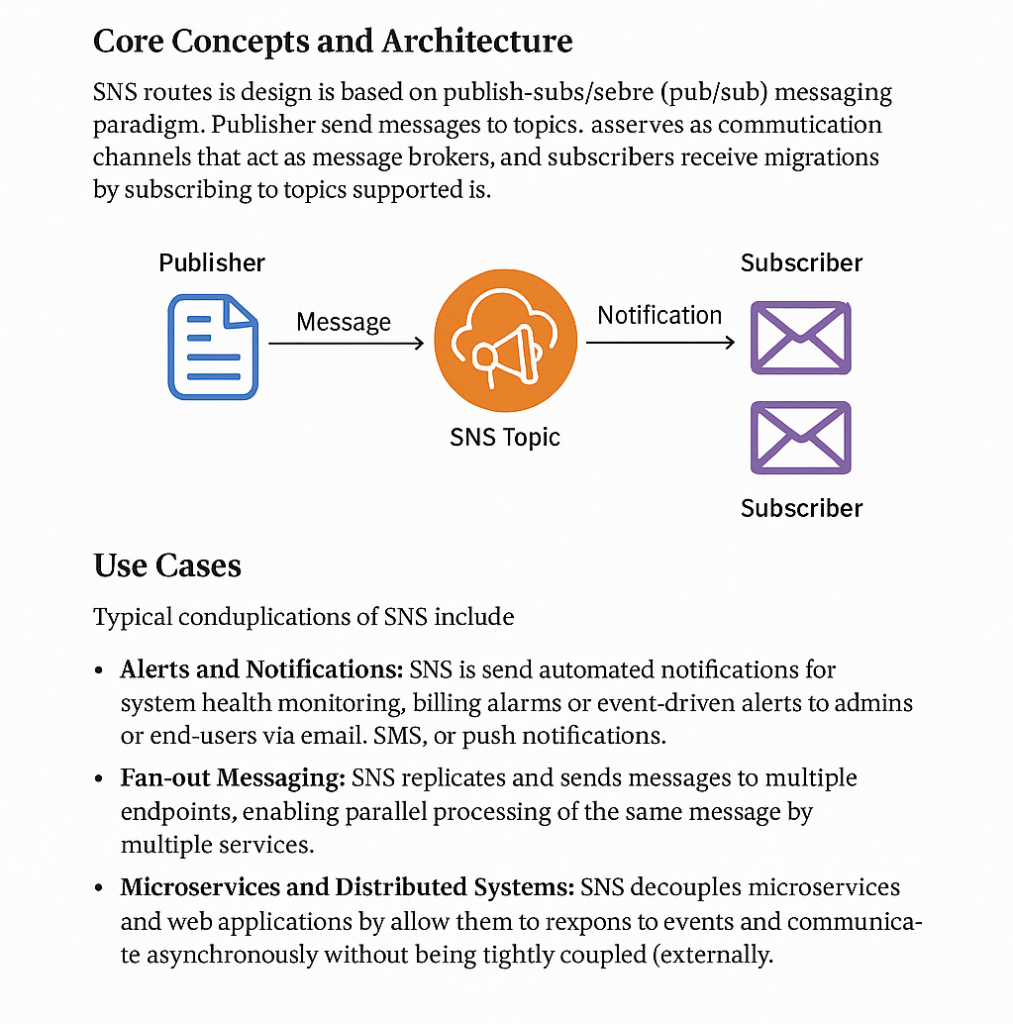
At the heart of SNS lies the Topic — a logical access point for message distribution. Publishers send messages to a topic, and subscribers (like SQS queues, Lambda functions, or HTTPS endpoints) receive the messages.
The workflow typically looks like this:
- Publisher sends a message to an SNS Topic.
- The Topic pushes that message to all Subscribed Endpoints.
- Each subscriber processes the message independently.
This pub/sub model allows asynchronous communication, enabling developers to scale microservices independently without tight coupling.
Architecture Diagram
The diagram below illustrates a typical SNS flow — a publisher sends a message to a topic, which distributes it to multiple subscribers such as Lambda functions, SQS queues, or HTTP endpoints.
Integration Example
Let’s look at a simple example of integrating SNS with AWS Lambda using Python (Boto3):
This snippet publishes a notification message to an SNS topic. Any subscribers (e.g., Lambda, email, SQS) associated with that topic will receive the message instantly.
Developers can also subscribe endpoints dynamically using:
This flexibility allows adding or removing subscribers at runtime without modifying the publisher.
Common Use Cases
- System Alerts and Notifications – Trigger automatic messages when EC2 instances fail health checks or when CloudWatch alarms are triggered.
- Fan-out Messaging – Send a single event to multiple services simultaneously (e.g., one Lambda for logging, one for metrics).
- Event-driven Architecture – Decouple microservices by allowing one service to trigger workflows in others asynchronously.
- Mobile Push Notifications – Integrate SNS with Firebase Cloud Messaging (FCM) or Apple Push Notification Service (APNs) to send mobile alerts.
Best Practices
- Use Dead-Letter Queues (DLQs): Capture undeliverable messages for debugging and retry logic.
- Enable Message Filtering: Use message attributes to control which subscribers receive specific messages.
- Secure Topics: Restrict access using IAM policies and encryption with AWS KMS.
- Monitor with CloudWatch: Track delivery success rates, latency, and retry counts.
Conclusion
AWS SNS is a foundational service for event-driven architectures, providing developers with scalable, fault-tolerant, and loosely coupled messaging capabilities. Whether you’re sending alerts, triggering serverless workflows, or distributing events to multiple microservices, SNS ensures reliability and speed in message delivery.
For developers building resilient cloud-native systems, mastering SNS is a must-have skill in the AWS ecosystem.