

Overview
- Digital payments are now an essential component of modern online businesses. E-commerce platforms, SaaS applications, marketplaces, and subscription-based services all rely on secure and scalable payment gateways to process transactions from customers. Razorpay is one of India’s leading payment gateway providers that allows businesses to accept payments through multiple methods including UPI, credit cards, debit cards, wallets, and net banking.
- Razorpay provides developer-friendly APIs, SDKs for multiple programming languages, and enterprise-grade security infrastructure. Its ecosystem includes payment processing, subscription billing, payment links, automated settlements, and financial analytics dashboards. Because of these features, Razorpay has become a preferred solution for startups, enterprises, and SaaS companies that require a reliable payment infrastructure.
Razorpay Payment Integration Architecture
- The architecture below illustrates how Razorpay integrates with a web application. The payment flow involves the frontend application, the backend server responsible for creating payment orders, the Razorpay payment gateway that processes transactions, and webhook notifications that inform the merchant server about payment status changes.
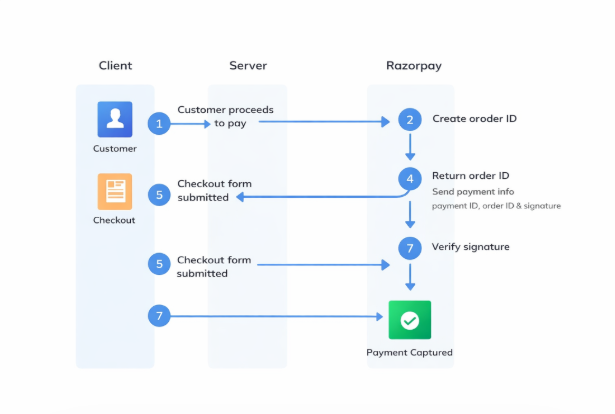
Figure: Razorpay Payment Gateway Integration with Webhooks
Key Features of Razorpay
- Supports multiple payment methods such as UPI, cards, wallets, and net banking.
- Provides powerful REST APIs for backend integration.
- Offers hosted checkout page for easy frontend integration.
- Real-time webhook notifications for payment events.
- Built-in analytics dashboard for monitoring transactions.
- Subscription billing support for SaaS businesses.
Payment Methods Supported
| Payment Method | Description | Use Case |
|---|---|---|
| UPI | Instant bank-to-bank transfers | Mobile payments |
| Credit/Debit Cards | Visa, Mastercard, RuPay | E-commerce checkout |
| Net Banking | Direct payment via bank login | Traditional online payment |
| Wallets | Paytm, PhonePe wallets | Quick mobile payments |
Steps to Integrate Razorpay
The Razorpay integration process involves several steps that ensure secure payment processing and accurate transaction tracking.
- Create a Razorpay merchant account and generate API credentials.
- Create a payment order on the backend using Razorpay APIs.
- Integrate Razorpay Checkout on the frontend application.
- Allow the user to complete payment through supported payment methods.
- Verify payment signature on the backend server.
- Process Razorpay webhook events to update order status.
Understanding Razorpay Webhooks
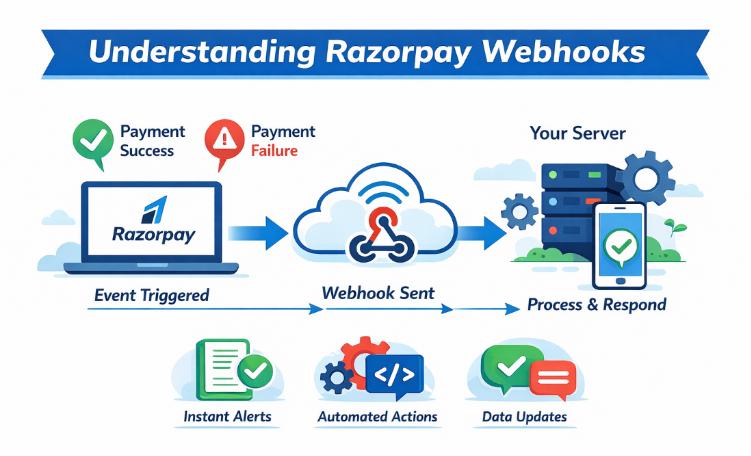
- Webhooks are automated HTTP callbacks sent by Razorpay when certain payment events occur. These events allow the merchant’s server to receive real-time notifications about payment status changes. For example, when a payment is successfully captured, Razorpay sends a payment captured event to the webhook endpoint configured by the merchant.
- Webhooks are extremely useful for automating backend processes. Once the webhook event is received and verified, the application can update the payment status in the database, generate invoices, send confirmation emails to customers, or trigger additional business logic.
Benefits of Using Razorpay
- Multiple Payment Options – Supports credit cards, debit cards, UPI, net banking, wallets, and EMI.
- Easy Integration – Provides APIs, SDKs, and plugins for platforms like React, Angular, Shopify, WooCommerce, and mobile apps, making integration easier for developers.
- Subscription Management – Allows businesses to create recurring payments for SaaS products, memberships, and subscription services.
- Fast Settlements – Businesses receive payments directly in their bank accounts with relatively quick settlement cycles.
- Secure Transactions – Razorpay is PCI DSS compliant and uses encryption and security protocols to protect payment data.
- Payment Links – Businesses can generate payment links and send them through email, SMS, or WhatsApp without building a full payment website.
- Smart Dashboard & Analytics – Provides a dashboard to track payments, refunds, settlements, and transaction reports.
- International Payments – Businesses can accept payments from international customers in multiple currencies.
- Automated Invoices – Razorpay can generate invoices automatically, making billing easier for businesses and freelancers.
- Marketplace Support (Split Payments) – Allows marketplaces to split payments between multiple vendors automatically.
- Developer-Friendly Tools – Offers webhooks, APIs, and testing environments to build scalable payment systems.
- UPI Optimization – Since Razorpay is built for India, it provides strong UPI support, which is widely used for online payments.
Potential Drawbacks
- Transaction fees can affect small businesses, especially those with low profit margins.
- Dependence on third-party payment infrastructure, meaning service outages or technical issues can impact transactions.
- Customization requires backend development knowledge, which may be challenging for non-technical businesses.
- Settlement cycles depend on banking infrastructure, so delays can sometimes occur in receiving funds.
- Customer support delays may affect businesses if payment issues arise and quick assistance is needed.
- Primarily optimized for Indian businesses, so global payment capabilities may be limited compared to some international gateways.
- KYC verification and account approval may take time, which can delay the onboarding process for new merchants.
Real-World Use Cases
- Marketplace Platforms – Platforms like service marketplaces or multi-vendor stores use Razorpay to collect payments from customers and automatically split the amount between vendors.
- Mobile Applications – Mobile apps integrate Razorpay SDK to accept in-app payments for services, subscriptions, or digital products.
- Donation & Fundraising Platforms – NGOs and charities use Razorpay to accept secure online donations through websites or payment links.
- Event Ticketing Systems – Event organizers use Razorpay to sell tickets online and collect payments instantly.
- Freelancers & Consultants – Freelancers can generate payment links or invoices and send them to clients for easy payment collection.
- Educational Institutions – Schools, colleges, and training institutes use Razorpay to collect tuition fees, course payments, and exam fees.
- Utility Bill Payments – Businesses can integrate Razorpay to allow customers to pay bills such as electricity, internet, or service subscriptions.
- Digital Product Sales – Creators selling e-books, software licenses, templates, or online content use Razorpay to process payments.
- Booking & Reservation Systems – Hotels, travel agencies, and appointment booking platforms use Razorpay to collect advance payments or booking fees.
- Subscription-based Communities – Membership websites or premium communities use Razorpay subscriptions to charge recurring membership fees.
- Online Gaming Platforms – Gaming platforms use Razorpay for wallet top-ups, in-game purchases, or tournament entry fees.
Conclusion
- Razorpay has become one of the most powerful and developer-friendly payment gateway solutions in India. With secure infrastructure, simple APIs, webhook-based event handling, and support for multiple payment methods, Razorpay enables businesses to implement modern digital payment systems quickly and efficiently.
- For developers and product teams, Razorpay provides the necessary tools to build scalable and reliable payment experiences. Although transaction fees and external dependency should be considered, the benefits of reliability, automation, and seamless integration make Razorpay a strong choice for modern digital businesses.