
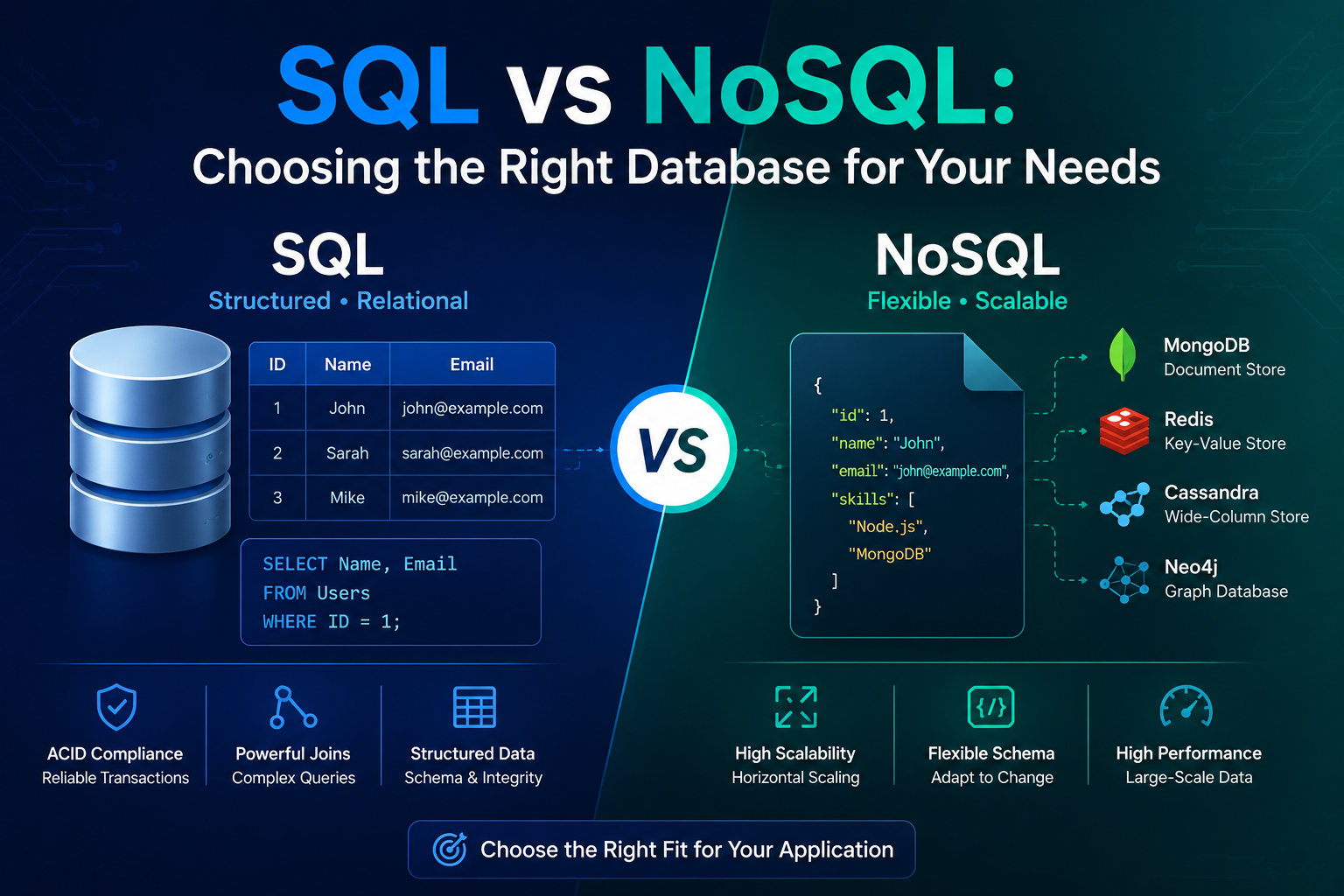
Introduction:
Choosing the right database is one of the most important decisions when developing an application. Databases store and manage the data that powers your application, and the choice between SQL (Structured Query Language) and NoSQL (Not Only SQL) can significantly impact performance, scalability, and flexibility.
SQL databases are structured and use predefined schemas, making them ideal for applications that require complex queries and transactions. On the other hand, NoSQL databases offer a more flexible approach, allowing for dynamic and unstructured data storage, which is great for handling large-scale and rapidly changing data.
In this blog, we’ll dive into the key differences between SQL and NoSQL databases, explore their pros and cons, and help you determine which type is best suited for your specific use case.
What’s SQL?
SQL databases, also known as relational databases, organize data into structured tables with rows and columns. Each table follows a predefined schema, which outlines the structure of the data — including the types of information stored in each column. This structure ensures consistency and integrity, especially in applications that rely on complex relationships between different data points. SQL, or Structured Query Language, is the standard language used to interact with these databases, allowing developers to perform tasks like querying, updating, and managing data efficiently. Some of the most widely used SQL databases include MySQL, PostgreSQL, Oracle, and Microsoft SQL Server — all known for their reliability, strong support for transactions, and suitability for applications where data consistency is critical.
Advantages of SQL Databases
1. Structured and Consistent Data
SQL databases use clearly defined schemas, which means the structure of the data is set from the beginning. This makes it easier to maintain consistency across the database, as each table has a fixed format and expects specific types of data. This is especially helpful in large applications where data integrity is crucial.
2. ACID Compliance for Reliability
One of the biggest strengths of SQL databases is their support for ACID properties — Atomicity, Consistency, Isolation, and Durability. These properties ensure that all transactions are processed reliably and safely. This makes SQL databases an excellent choice for systems that handle sensitive data, such as banking, accounting, and other financial applications.
3. Advanced and Powerful Query Capabilities
SQL is a very expressive and powerful language when it comes to querying data. Features like JOINs allow data from multiple tables to be combined, while functions like GROUP BY and various aggregation tools make it easy to analyze and manipulate data. This makes it ideal for generating reports or performing complex data operations.
What is a NoSQL Database?
Unlike traditional relational databases, NoSQL databases don’t follow a fixed schema or table-based structure. They’re built to handle unstructured or semi-structured data, which makes them a great fit for applications that need flexibility and scalability. This approach allows developers to store and retrieve data without worrying about strict formats, making it easier to adapt to changing data requirements over time.
Instead of using tables like in SQL databases, NoSQL databases store data in a variety of formats depending on the type. These can include document-based formats (like JSON), key-value pairs, graph structures, or wide-column stores. This variety gives developers the freedom to choose the best model for their specific use case.
Some of the most popular NoSQL databases include MongoDB, known for its document-oriented model Cassandra, ideal for handling large volumes of distributed data Redis, a fast in-memory key-value store; and Couchbase, which offers both document and key-value storage with strong performance capabilities.