
Introduction
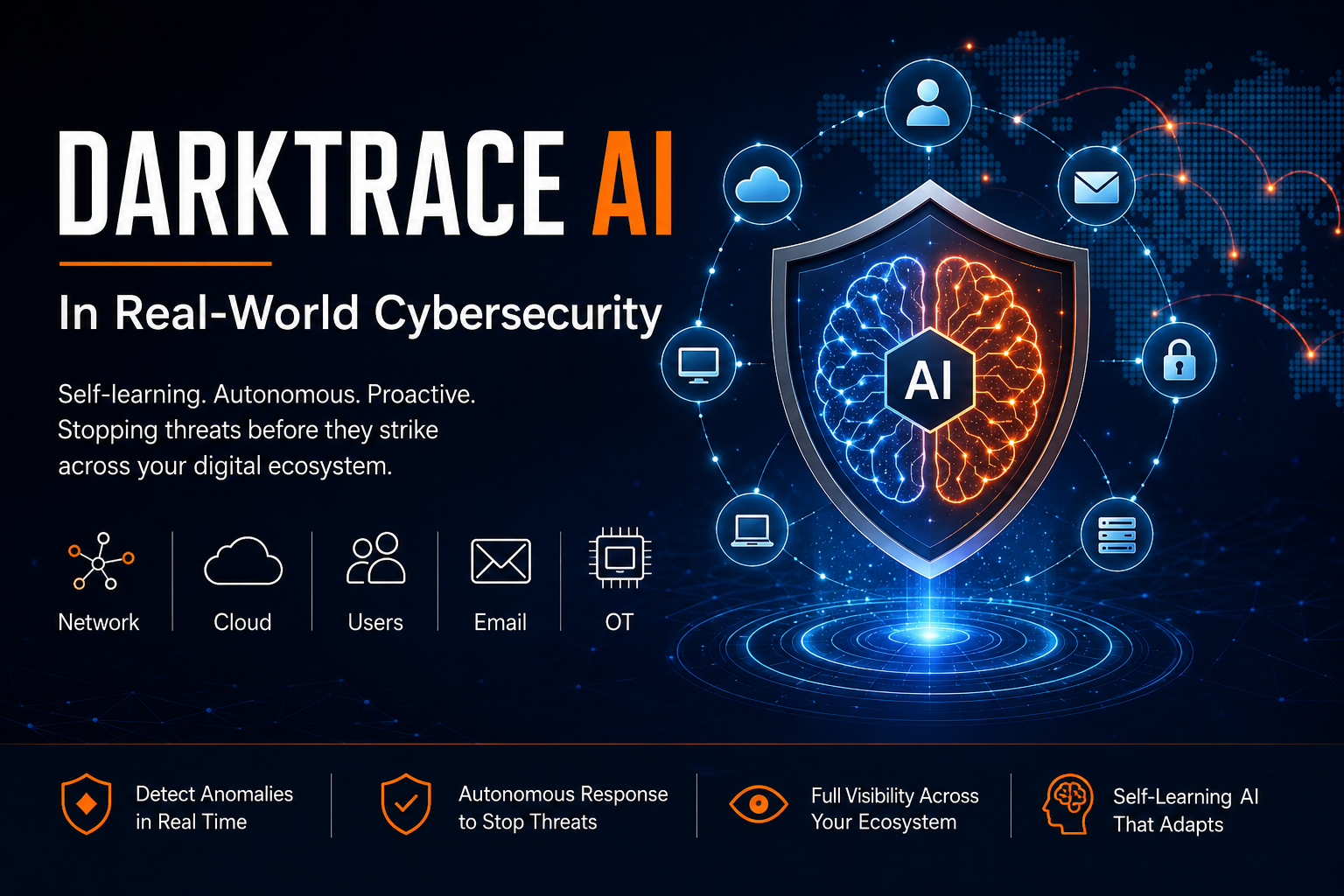
As cyber threats continue to evolve, businesses face an unprecedented need for intelligent and autonomous defense systems. Traditional rule-based security tools are no longer sufficient to detect and respond to sophisticated, fast-moving threats. Darktrace AI steps in as a groundbreaking solution—employing self-learning, unsupervised machine learning to proactively identify and neutralize anomalies across networks, devices, users, and applications.
Developed by mathematicians and AI experts from the University of Cambridge, Darktrace doesn’t just detect known threats—it anticipates and stops unknown ones in real time.
What is Darktrace AI?
Darktrace AI is an autonomous cybersecurity platform powered by artificial intelligence. It monitors network activity to detect abnormal behavior and automatically takes action to prevent security incidents. It is based on the concept of an “Enterprise Immune System,” mimicking how a human immune system learns and responds to threats.
- Networks (internal/external)
- Cloud environments (AWS, Azure, GCP)
- SaaS platforms (Microsoft 365, Google Workspace)
- Email systems
- Operational technology (OT) environments
Real Use Cases of Darktrace AI
1. Stopping Phishing Emails in Real-Time
Problem: A high-ranking executive received a targeted spear-phishing email with a malicious attachment.
Darktrace Response: Identified the anomaly in sender behavior and link redirection in the email. Darktrace’s Antigena Email module prevented the email from reaching the inbox.
Result: No user interaction, no breach. Executive remained unaware of the attack attempt.
2. Insider Threat Detection
Problem: A departing employee started downloading large volumes of intellectual property.
Darktrace Response: Flagged the behavior as an anomaly based on prior user behavior and alerted security in real time.
Result: Security team intervened before data exfiltration was completed.
3. Ransomware Mitigation
Problem: Ransomware began encrypting shared files and attempting to spread across devices.
Darktrace Response: Detected unusual encryption activity, isolated the infected device, and stopped lateral movement.
Result: No critical systems were affected, and recovery time was drastically reduced.
4. Cloud Misconfiguration Exploitation
Problem: A compromised admin API key in AWS was being used for privilege escalation.
Darktrace Response: Detected abnormal activity in AWS CloudTrail logs and generated an autonomous response to lock the session.
Result: Attack was contained without any downtime.
5. Zero-Day Exploit Prevention
Problem: Unknown malware exploiting a zero-day vulnerability began communicating with an external server.
Darktrace Response: Flagged the communication as anomalous despite no prior signature. Isolated the device and stopped exfiltration.
Result: Threat mitigated before malware could spread.
How to Implement Darktrace AI in Your Organization
1. Deploy Sensors (Darktrace Probes)
Deploy virtual or physical sensors on-prem and across cloud platforms to start monitoring traffic.
2. Allow Learning Period (1-2 Weeks)
Darktrace learns the “patterns of life” unique to your organization—user behavior, device activity, traffic norms.
3. Enable Autonomous Response (Antigena)
Once baseline is established, enable Antigena modules to begin automatic threat responses (can be set to passive or active).
4. Integrate with SIEM/Incident Management Tools
Export alerts and metrics to existing tools like Splunk, QRadar, or ServiceNow.
5. Train Security Teams Using Threat Visualizer
Use Darktrace’s intuitive interface to monitor and investigate incidents in real time.
Benefits of Using Darktrace AI
- Real-time threat detection without predefined rules
- Autonomous response to stop attacks mid-breach
- Visibility across IT, OT, SaaS, and Cloud
- No need for manual tuning or threat intelligence feeds
- Reduces load on SOC teams with automated triage
- Fast deployment (minimal setup time)
Limitations & Considerations
- False Positives: Initial learning may generate noise if the environment is very dynamic
- Cost: Premium solution with pricing based on environment size
- Opaque AI Decisions: Some security teams may require more transparency in how decisions are made
- Dependence on Continuous Monitoring: Disabling sensors or data loss may reduce efficacy
Conclusion
Darktrace AI represents a shift from traditional reactive security models to proactive, self-defending architectures. By mimicking the human immune system, it offers a smarter way to detect and mitigate threats—often before they escalate.
From protecting against insider threats to neutralizing ransomware and zero-day exploits, Darktrace empowers organizations with true cyber resilience.