
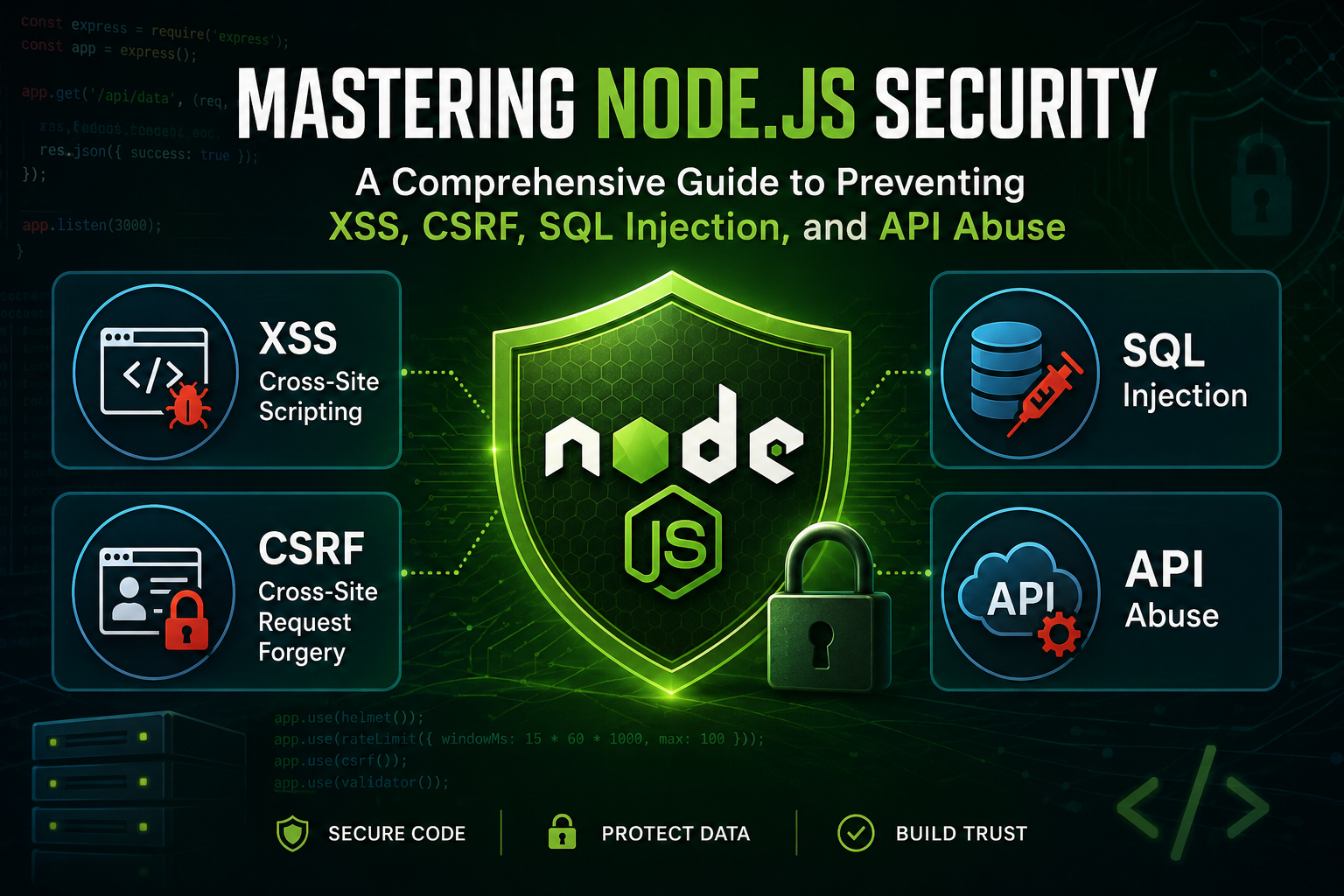
In the fast-paced world of web development, Node.js has become a cornerstone for building scalable, high-performance applications. However, with great power comes great responsibility—especially when it comes to security. Vulnerabilities like Cross-Site Scripting (XSS), Cross-Site Request Forgery (CSRF), SQL Injection, and API Abuse can expose your application to devastating attacks, leading to data breaches, unauthorized access, and service disruptions.
This blog post dives deep into these threats, explaining how they work end-to-end in a Node.js environment, and provides practical, actionable strategies to prevent them. We’ll cover everything from the mechanics of each attack to implementation details using popular libraries like Express.js, Helmet, and more.
Whether you’re a beginner securing your first API or a seasoned developer hardening enterprise-grade systems, this guide will equip you with the knowledge to build resilient Node.js applications. Let’s break it down step by step.
Understanding the Threats: Why Node.js Apps Are Vulnerable
Node.js, with its event-driven architecture and non-blocking I/O, excels at handling real-time applications and APIs. But its flexibility—often involving user inputs, databases, and third-party integrations—creates entry points for attackers. Common culprits include unvalidated inputs, improper session management, and lax API controls.
- XSS (Cross-Site Scripting): Attackers inject malicious scripts into web pages viewed by other users.
- CSRF (Cross-Site Request Forgery): Tricks users into performing unintended actions on a web application where they’re authenticated.
- SQL Injection: Manipulates database queries through unsanitized inputs, potentially exposing or altering data.
- API Abuse: Overuse or misuse of APIs, leading to rate limiting bypasses, data scraping, or denial-of-service (DoS) attacks.
1. Preventing Cross-Site Scripting (XSS)
How XSS Works End-to-End in Node.js
XSS occurs when an attacker injects client-side scripts (e.g., JavaScript) into your app’s output, which then executes in a victim’s browser. In a Node.js app using Express, this might happen if you render user-generated content without escaping it.
Consider a simple blog app where users post comments. An attacker submits a comment like:
If your server renders this directly in HTML, the browser executes the script, potentially stealing cookies or redirecting to phishing sites.
End-to-end flow:
- User submits malicious input via a form or API.
- Node.js processes it (e.g., stores in MongoDB or PostgreSQL).
- When rendering the page or API response, the input is outputted raw.
- Victim’s browser parses the HTML/JSON, executing the script.
Types of XSS:
- Reflected: Payload in URL/query params, reflected back immediately (e.g., search results).
- Stored: Payload saved in DB and served later (e.g., comments).
- DOM-based: Client-side JS manipulates DOM with untrusted data.
Prevention Strategies in Node.js
To mitigate XSS, adopt a defense-in-depth approach:
1. Input Validation and Sanitization:
- Use libraries like validator.js or joi to validate inputs.
- Sanitize outputs with DOMPurify (for client-side) or server-side equivalents.
Example with Express:
2. Content Security Policy (CSP):
- Use Helmet middleware to set HTTP headers that restrict resource loading.
- Example:
This prevents inline scripts unless explicitly allowed, blocking most XSS payloads.
3. Output Encoding:
- Always encode user data when rendering.For HTML, use template engines like Pug or EJS with auto-escaping.
- In API responses, ensure JSON is properly stringified to avoid script injection.
4. Best Practices:
- Avoid innerHTML in client-side code; use textContent instead.
- Regularly scan with tools like OWASP ZAP or Snyk.
- For stored XSS, sanitize on input and output.
2. Preventing Cross-Site Request Forgery (CSRF)
How CSRF Works End-to-End in Node.js
CSRF exploits the trust a site has in a user’s browser. If a user is logged in to your Node.js app (e.g., via sessions), an attacker can trick them into submitting a forged request from another site.
End-to-end flow:
- User authenticates, receiving a session cookie.
- Attacker crafts a malicious site with hidden forms/images that submit to your app.
- Browser automatically includes cookies, executing the action.
In Node.js with Express-Session, if no CSRF protection exists, state-changing requests (POST/PUT/DELETE) are vulnerable.
Prevention Strategies in Node.js
CSRF tokens are the gold standard—unique, per-request values tied to the user’s session.
1. Using csurf Middleware:
- Install csurf and integrate with Express.
- Example:
<form action="/process" method="POST">
  <input type="hidden" name="_csrf" value="${req.csrfToken()}" />
  <!-- Other fields -->
</form>
`);
});
app.post(‘/process’, (req,res) => {
//csurf will validate the token automatically
res.send(‘Processed’);
});
This generates a token on GET, validates on POST.
2. Double-Submit Cookie Pattern:
- For stateless apps (e.g., JWT), send token in cookie and request body/header, then compare.
3. SameSite Cookies:
- Set SameSite=Strict or Lax on session cookies to prevent cross-site inclusion.
4. Best Practices:
- Use tokens for all mutating requests.
- Combine with CORS restrictions (e.g., cors middleware).
- Avoid GET for state changes.
3. Preventing SQL Injection
How SQL Injection Works End-to-End in Node.js
SQL Injection (SQLi) happens when untrusted input is concatenated into SQL queries, allowing attackers to alter query logic.
In Node.js with libraries like pg (PostgreSQL) or mysql, a query like:
can be exploited with input like:
End-to-end flow:
- User sends input via query param or body.
- Node.js builds and executes the raw SQL.
- Database interprets malicious commands, leading to data leaks or destruction.
Blind SQLi (no direct output) can still exfiltrate data via timing attacks.
Prevention Strategies in Node.js
Parameterized queries and ORMs are key.
1. Parameterized Queries:
- Use placeholders instead of concatenation.
- With pg:
The driver handles escaping.
2. ORMs like Sequelize or TypeORM:
- Abstract queries, automatically parameterizing.
- Example with Sequelize:
3. Input Validation:
- Use joi for schema validation.
- Ensure IDs are integers, emails valid, etc.
4. Best Practices:
- Least privilege: Database users with minimal permissions.
- Stored procedures for complex queries.
- Monitor with tools like SQLMap for vulnerabilities.
4. Preventing API Abuse
How API Abuse Works End-to-End in Node.js
API Abuse includes rate limiting evasion, scraping, brute-force, or DoS. In Node.js REST/GraphQL APIs, unchecked requests can overwhelm servers or leak data.
End-to-end flow:
- Attacker sends excessive requests (e.g., via bots).
- Node.js processes each, consuming CPU/DB resources.
- System slows or crashes; sensitive data exposed if no auth.
Examples: Credential stuffing or scraping endpoints without limits.
Prevention Strategies in Node.js
Layered controls are essential.
1. Rate Limiting:
- Use express-rate-limit.
- For advanced systems: Redis-backed distributed rate limiting.
2. Authentication and Authorization:
- JWT with jsonwebtoken for stateless auth.
- OAuth2 for third-party integrations.
- Role-based access using libraries like passport.
3. Captcha and Bot Detection:
- Integrate reCAPTCHA for sensitive endpoints.
- Monitor user-agent and behavior.
4. API Keys and Monitoring:
- Generate per-user keys with expiration.
- Use tools like Prometheus for metrics, alerting on anomalies
5. Best Practices:
- Pagination for large responses.
- Web Application Firewall (WAF) like ModSecurity.
- GraphQL-specific: Depth limiting with graphql-depth-limit.
Wrapping Up: Building a Secure Node.js Ecosystem
Securing Node.js isn’t a one-time task—it’s an ongoing process. Start with the basics: Validate inputs, sanitize outputs, use secure libraries, and test rigorously (e.g., with Jest for unit tests, Burp Suite for pentesting).
Adopt DevSecOps: Integrate security in CI/CD with Snyk or Dependabot.
Remember, no single measure is foolproof; layer defenses. For production, consider HTTPS (Let’s Encrypt), regular audits, and compliance with standards like OWASP Top 10.
By addressing XSS, CSRF, SQL Injection, and API Abuse end-to-end, you’ll create robust applications that protect users and data.
If you’re implementing these in a project, share your experiences in the comments—security is a community effort!
Stay secure, and happy coding! 🚀